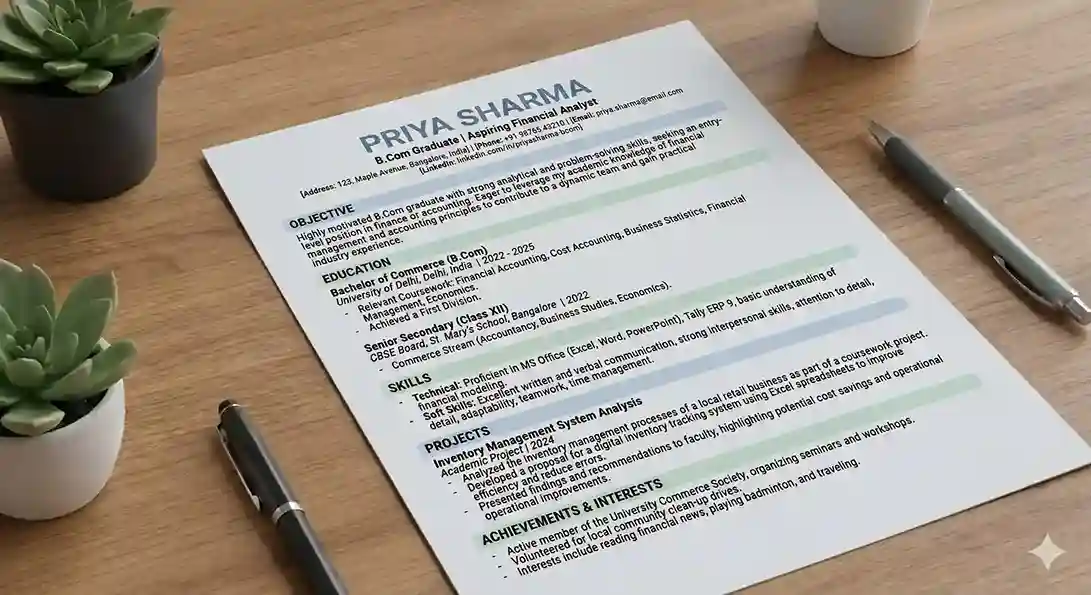
If you’re a fresher in India, you might feel that you have “no experience” to put on your resume. The truth is, companies hiring freshers know you won’t have full-time experience—they look for potential, attitude, and learning ability.
Sections Every Fresher Resume Must Have
- Contact Information and basic details.
- Short Resume Summary or Objective.
- Education with key academic details.
- Projects (academic, personal, or internships).
- Technical Skills and Tools.
- Certifications and Online Courses.
- Optional: Extracurricular activities, Positions of Responsibility, or Achievements.
1Write a Simple, Focused Summary
Avoid long career objectives like “To work in a challenging environment where I can utilise my skills…”. Recruiters have seen these lines thousands of times.
Good Fresher Summary (B.Tech CSE)
Computer Science graduate with a strong foundation in data structures, algorithms, and web development. Completed 3 academic projects using React, Node.js, and MongoDB, including a placement portal used by 200+ students. Actively looking for entry-level roles in full-stack development.
2Highlight Education the Right Way
For freshers, education is often the strongest section. Place it above projects if your academic performance is strong.
- Include degree, college/university name, location, and year of completion.
- Mention CGPA or percentage if it is decent (for example, 7.0+ CGPA).
- Add 1–2 relevant subjects only if they directly support the role (e.g., Data Structures, Operating Systems for software roles).
3Use Projects to Replace Work Experience
Your projects show how you apply what you’ve learned. Treat them like mini work experiences with outcomes and responsibilities.
- Include academic projects, hackathon projects, mini-projects, and serious personal projects.
- For each project, mention: title, tech stack, your role, and outcome or result.
- Avoid vague lines like “Developed a website for college” without details.
Project Entry Example
Online Food Ordering System | HTML, CSS, JavaScript, PHP, MySQL Built a full-stack web app that allowed users to browse menu items, add them to a cart, and place orders. Implemented an admin dashboard to manage orders and update menu items. Tested with 30+ students and reduced manual order processing time for the canteen by 60%.
4Choose Skills That Match Your Target Role
Don’t list every software you have ever installed on your laptop. Focus on skills you can actually use in an interview or job.
- Group skills by category: Programming Languages, Frameworks, Tools, Soft Skills.
- Include tools relevant to your domain (e.g., Figma for design, Excel for data, Tally for accounts).
- Don’t add generic skills like MS Word and PowerPoint unless applying for very basic roles.
5Internships, Volunteering, and Part-Time Work
Even short internships, NGO work, or college club responsibilities count as experience. They show initiative, responsibility, and exposure to real work.
- Treat each internship like a job: role, organisation, duration, and bullet points.
- Include what you actually did and any outcomes, not just “worked as intern”.
- Volunteering for college events or NGOs can be added under ‘Positions of Responsibility’ or ‘Volunteer Experience’.
6Common Fresher Mistakes to Avoid
- Adding a photo, date of birth, religion, or full postal address (unnecessary in most cases).
- Using long, decorative templates that are not ATS-friendly.
- Writing very long paragraphs instead of crisp bullet points.
- Including false skills or fake internships—recruiters recognise patterns quickly.